
Marketing Is More Than a Department – It’s a Way of Thinking
Marketing is often misunderstood—even in the most sophisticated organizations.
Too often, it’s seen as interchangeable with sales or business development. In reality, marketing enables those functions. Done right, it defines what the business stands for, who it serves, and how it creates value—not just how it sells.
Let’s break it down:
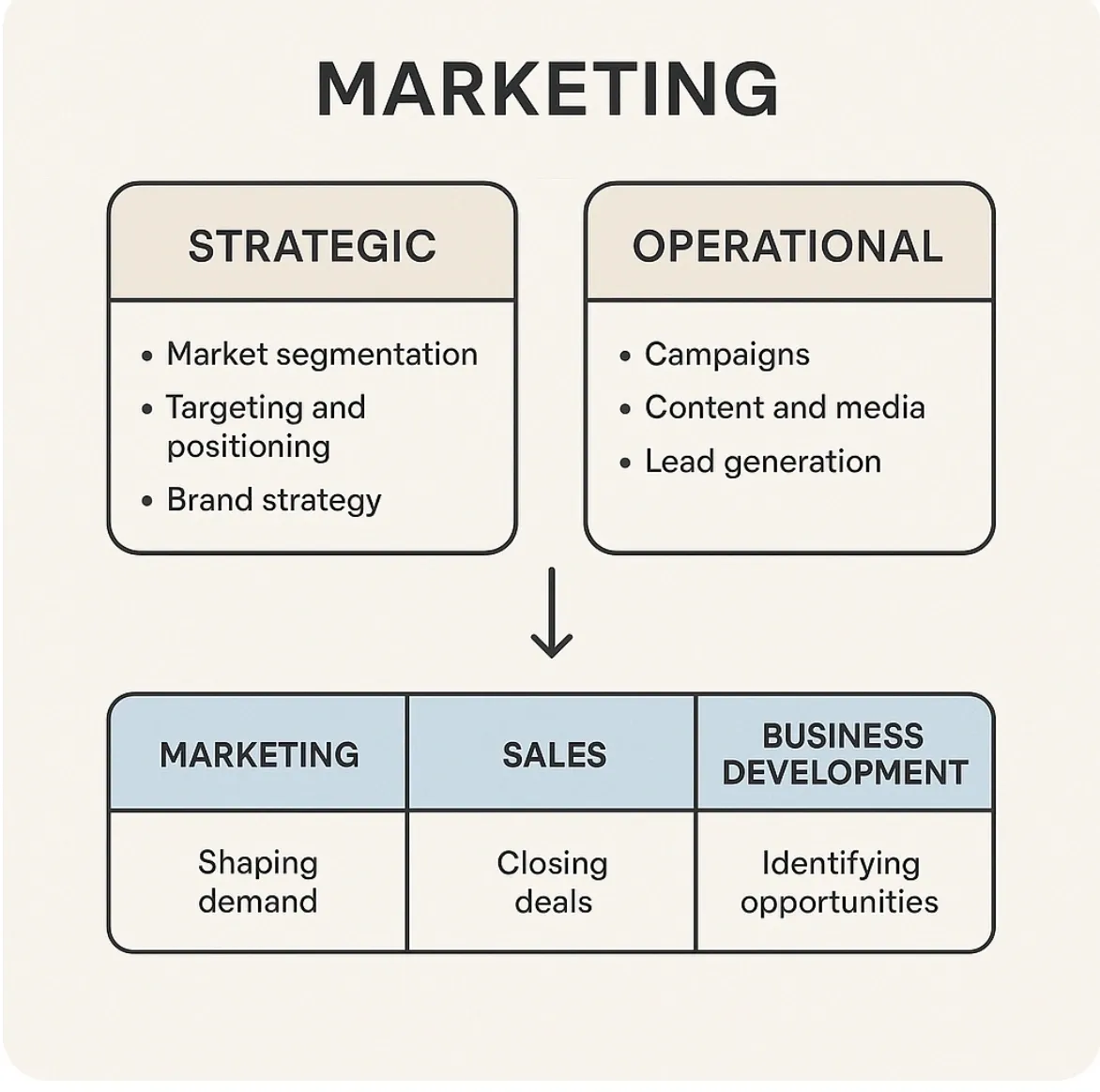
1. Strategic Marketing
This is the “why” and “who.”
- Market segmentation, targeting, and positioning (STP)
- Brand strategy
- Long-term value creation Think: Apple’s brand philosophy or Nike’s “Just Do It”—these aren’t tactics, they’re strategic anchors.
2. Operational Marketing
This is the “how” and “what.”
- Campaign planning
- Content and media buying
- Event execution, lead nurturing Think: launching a Super Bowl ad or optimizing SEO.
Strategic without operational = theory.
Operational without strategic = noise.
Schools of Thought:
- Peter Drucker once said, “The aim of marketing is to know and understand the customer so well the product or service fits him and sells itself.”
- The Kotler school emphasizes the 4Ps—Product, Price, Place, Promotion—but in modern B2B, we now see a shift toward solutions, value co-creation, and relationship marketing.
Common Confusion:
In many organizations, marketing gets folded under sales—or treated as just “design and social media.”
- Sales is focused on the close.
- Business development is focused on opportunity creation.
- Marketing should shape demand and customer perception at scale.
Examples:
- IBM: Known for shifting from hardware to consulting and cloud by repositioning their entire brand strategy—a marketing-led transformation.
- Tesla: Rarely advertises, but dominates public attention through product-driven storytelling and brand positioning.
- Slack: Grew fast through product-led growth, but strategic marketing positioned them as “email killers” long before sales teams got involved.
In today’s world, marketing is both art and science. But above all—it’s strategic.
Let’s stop conflating marketing with sales execution. It’s time for more organizations to put marketing back at the strategy table.
Would love to hear:
How does your organization draw the line between marketing, sales, and biz dev?