
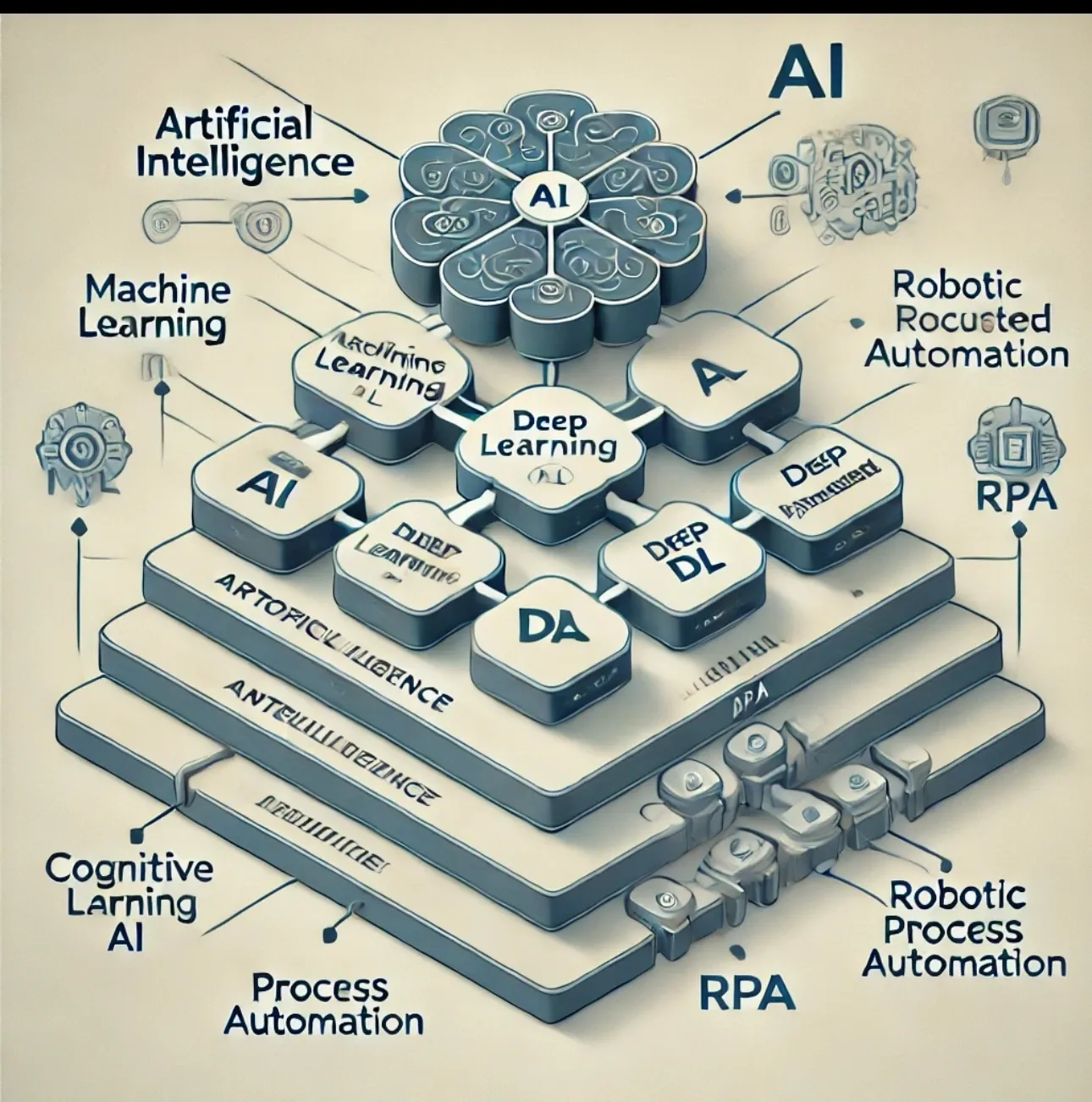
Artificial Intelligence (AI)
AI is a broad domain of computer science that aims to create systems capable of tasks requiring human-like intelligence, such as learning, reasoning, problem-solving, and understanding natural language. Under AI, various specialized technologies are categorized, each serving distinct purpose.
1. Machine Learning (ML)
Machine Learning is a subset of AI that uses data to train models and improve their performance over time without explicit programming.
Types of ML:
• Supervised Learning: Predict outcomes from labeled data.
• Unsupervised Learning: Find hidden patterns in unlabeled data.
• Reinforcement Learning: Optimize decision-making by learning from rewards and penalties.
2. Deep Learning (DL)
Deep Learning is a subfield of ML that relies on artificial neural networks. These networks mimic the human brain’s structure to extract features from data and solve complex problems like image recognition and natural language processing.
• Applications: Speech recognition, self-driving cars, and facial recognition.
3. Cognitive AI
Cognitive AI attempts to replicate human-like reasoning and understanding. It integrates elements like natural language processing (NLP), reasoning, and decision-making to simulate cognitive functions.
• Applications: Healthcare diagnostics, fraud detection, and business analytics.
4. Conversational AI
Conversational AI specializes in human-computer interaction through dialogue. It uses technologies like NLP, ML, and speech recognition to power chatbots and voice assistants.
• Examples: Alexa, Siri, and intelligent customer support systems.
5. Robotic Process Automation (RPA)
RPA is a distinct, automation-focused technology often grouped under the broader AI ecosystem. Unlike ML or DL, RPA is not “intelligent” on its own; it uses rule-based algorithms to automate repetitive, manual tasks.
Features:
• Automates structured processes like data entry or invoice processing.
• Often integrates with AI components like ML and NLP to handle unstructured tasks.
• Applications: Streamlining business operations, enhancing productivity in HR, finance, and customer service.
Categorization
Here’s how these technologies fit together:
1. AI (Artificial Intelligence): Encompasses all intelligent systems.
2. Machine Learning (ML): A subset of AI focusing on data-driven learning.
3. Deep Learning (DL): A further subset of ML specializing in neural networks.
4. Cognitive AI and Conversational AI: Focus on human-like reasoning and interaction.
5. RPA: While not strictly “intelligent,” it leverages AI to enhance process automation.
Key takeaway: Human brain is the reference..
Let us know your thoughts?