RPA vs. AI Agents: What’s the Difference—And Why It Matters
In today’s digital landscape, automation is no longer a luxury—it’s a necessity. But not all automation is created equal.
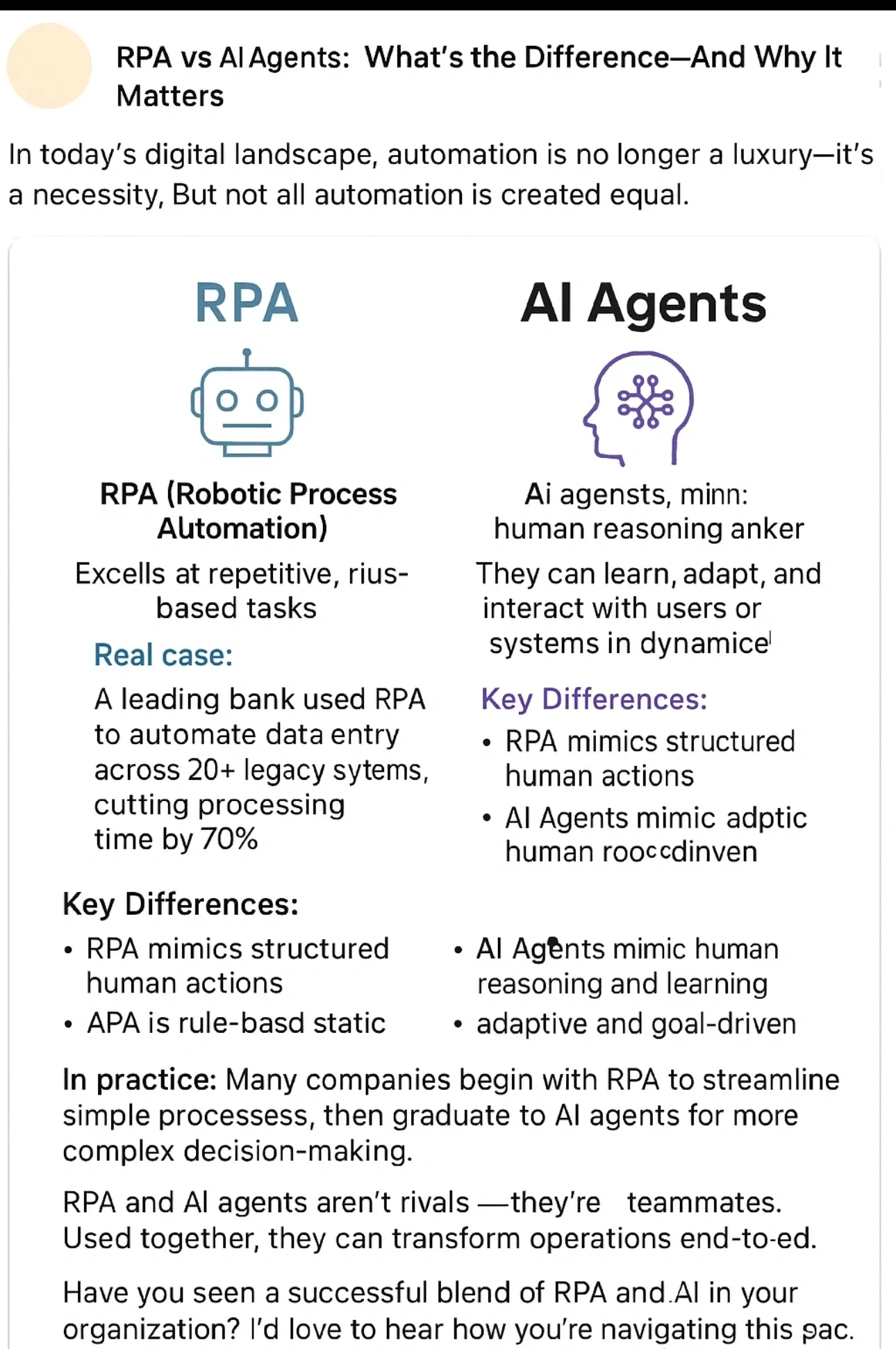
RPA (Robotic Process Automation) excels at repetitive, rules-based tasks. Think of it as your digital assembly line.
Real case: A leading bank used RPA to automate data entry across 20+ legacy systems, cutting processing time by 70%.
AI Agents, on the other hand, are autonomous decision-makers. They can learn, adapt, and interact with users or systems in dynamic environments.
Real case: A global e-commerce company deployed AI agents to handle customer service inquiries, including context-aware issue resolution, improving CSAT by 30%.
Key Differences:
• RPA mimics structured human actions
• AI Agents mimic human reasoning and learning
• RPA is rule-based and static
• AI Agents are adaptive and goal-driven
In practice: Many companies begin with RPA to streamline simple processes, then graduate to AI agents for more complex decision-making.
Bottom line: RPA and AI agents aren’t rivals—they’re teammates. Used together, they can transform operations end-to-end.
Have you seen a successful blend of RPA and AI in your organization? I’d love to hear how you’re navigating this space.
#AI #RPA #DigitalTransformation #Automation #IntelligentAutomation